
- +1
CCS Chemistry | Author Spotlight-吉林大学 杨英威教授
以下文章来源于CCSChemistry ,作者CCS Chemistry
 CCSChemistry
CCS Chemistry是由中国化学会创办的高水平旗舰新刊,面向全球科学家,收录化学各领域高质量原创科技论文。关注CCS Chemistry,即时获取期刊相关资讯。
人物介绍
Ying-Wei Yang (杨英威)
Prof. Ying-Wei Yang graduated from the Department of Chemistry at Nankai University with a B.S. in 2000. He received his Ph.D. in Physical Chemistry from Nankai University in 2005 under the direction of Prof. Liu Yu. From 2005 to 2010, he worked as a postdoctoral fellow at Arizona State University (with Professor John Chaput), University of California, Los Angeles (with Professor Sir Fraser Stoddart), and University of California, Irvine (with Professor Zhibin Guan). In 2011, he joined Jilin University as an Associate Professor. Since 2014, he has been working as a Full Professor at the College of Chemistry, Jilin University. Professor Yang's research interests include organic-inorganic hybrids, smart organic materials based on macrocycles, controlled release systems and stimuli-responsive (bio)polymers.
Q1: Who helped you the most as you pursued your research career?
Prof. Yang: My wife has fully supported me for over 20 years through thick and thin. She encouraged and helped me a lot, not only during my Ph.D. and postdoctoral trainings, but also after I started my independent research career at Jilin University in 2011. Without her sacrifice for the family, I would have no chance to focus on my research and achieve any of my goals. In terms of scientific research, I learned a lot from many talented scientists, in particular, my Ph.D. advisor, Professor Yu Liu, my postdoctoral supervisors, Profs. Sir Fraser Stoddart, John Chaput, and Zhibin Guan, as well as my colleagues such as Profs. Shouhua Feng, Jihong Yu, and Paul Weiss. They are the most influential people in my career.
Q2: What are some difficult challenges you have faced during your research career? How did you overcome them?
Prof. Yang: During my research career, the most difficult challenge I have had was that I was no longer able to continue my research as usual due to the diagnosis of acute myeloid leukemia early 2016. The fight against blood cancer during the past four years, with the unforgettable help from my doctors, parents, wife, siblings, kids, group members, and many friends, made me mature a lot and learned how to balance work and life. The illness made me strong, and the responsibilities to family and society made me directly face the difficulties and overcome them.
Q3: Who is(are) scientist(s) you most respect or admire? Why?
Prof. Yang: There are far too many good scientists I respect and admire. If I have to name a scientist that I most respect, Sir Fraser Stoddart, Nobel Laureate in Chemistry in 2016, is the one. Fraser is my postdoctoral supervisor, my academic father, and one of my best friends. He is my role model in many aspects, not only in scientific research.
Q4: What do you see as the biggest obstacles and most promising applications in your research area?
Prof. Yang: The biggest obstacle in my research area is the translation of our discoveries or findings into productivity. We have made some progress and impact in the highly interdisciplinary research area, but we are still far from real-world applications, which will apparently need the close collaborations between chemists, material scientists, engineers, medical doctors, industrial workers, etc.
Q5: What advice do you have for younger students and researchers beginning their careers in chemistry, and in particular those interested in your field?
Prof. Yang: My advice for the next generation of scientists is that you should always enjoy the freedom of doing science, but do not be afraid to tackle big problems, and never let failure slow you down. Do whatever you really love to do and stick with it with passion. Research is a long journey, maybe lifetime long for many scientists, and in order to stay motivated, you should take small steps, work smarter, and reward yourself whenever you meet a small milestone during this journey. A few more important tips: actively build your network, collaborate wisely, and don't be afraid to approach senior researchers or even well-known scientific leaders as they are often very supportive and encouraging.
Q6: Thank you for publishing your superb work in CCS Chemistry! Could you provide a brief summary of your article and research direction in a few sentences?
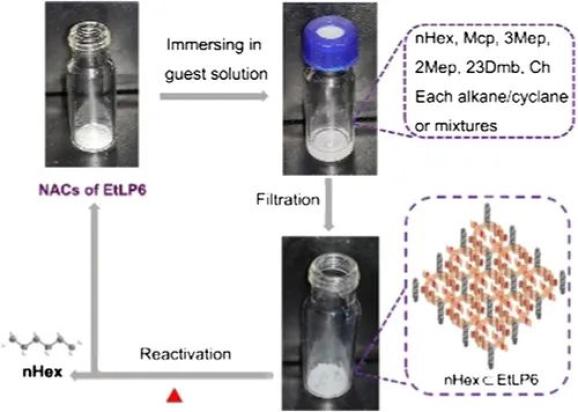
Prof. Yang: I am thrilled and thankful to have this chance to showcase our work in the flagship journal of Chinese Chemical Society. In this work, we reported an easy-to-operate and energy-efficient n-hexane purification strategy using nonporous adaptive crystals of leaning pillar[6]arene, a new version of synthetic macrocyclic arenes that were recently developed in our laboratory (Angew. Chem. Int. Ed. 2018, 57, 9853). This adaptive crystals preferentially absorbed n-hexane over other branched or cyclic C6 alkanes with similar boiling points, owing to the different thermodynamic stabilities and variabilities of leaning pillararene crystalloids loaded with n-hexane and other C6 alkanes. Currently in our laboratory, we are trying our best to solve more challenging separation problems using leaning pillararenes and their derivatives, toward our ultimate goal of industrial applications. For an introduction to this work in Chinese, readers may go to: https://mp.weixin.qq.com/s/JD5K26qsV96Ds5xG3heoSw.
Learn more: Jia-Rui Wu & Ying-Wei Yang*(杨英威). High-Performance n-Hexane Purification by Nonporous Adaptive Crystals of Leaning Pillar[6]arene. CCS Chem. 2020, 2, 836–843.
Link: https://doi.org/10.31635/ccschem.020.202000221
 扫描或长按左侧二维码
在线阅读全文
原标题:《CCS Chemistry | Author Spotlight-吉林大学 杨英威教授》
本文为澎湃号作者或机构在澎湃新闻上传并发布,仅代表该作者或机构观点,不代表澎湃新闻的观点或立场,澎湃新闻仅提供信息发布平台。申请澎湃号请用电脑访问http://renzheng.thepaper.cn。







- 报料热线: 021-962866
- 报料邮箱: news@thepaper.cn
互联网新闻信息服务许可证:31120170006
增值电信业务经营许可证:沪B2-2017116
© 2014-2026 上海东方报业有限公司