
- +1
Technological empowerment is key to the future
If technological breakthroughs can be made in the next 65 years at a speed comparable to that in the past 65 years, the future technological development will be even faster, Whitfield Diffie, said during a session of the 2021 Boao Forum for Asia (BFA) under the theme of Artificial Intelligence in the Post-Pandemic Era on April 19.
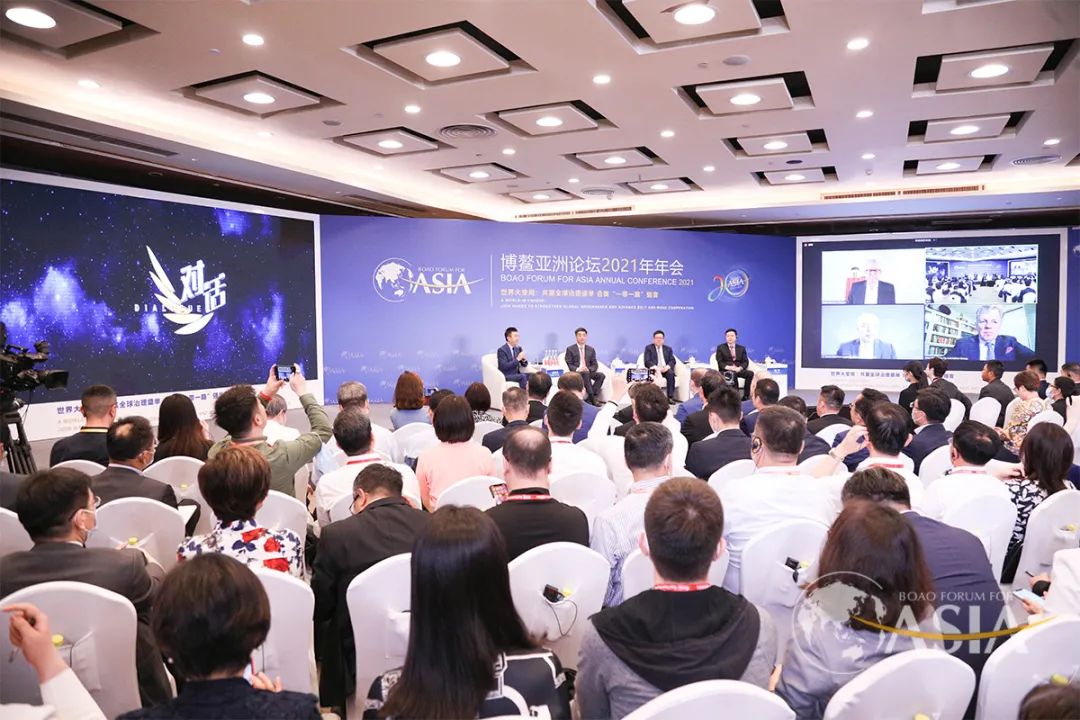 Understanding AI
The term “artificial intelligence” was coined in 1956 by John McCarthy, a researcher who later founded AI labs at MIT and Stanford. “65 years have passed, now I believe we will face both opportunities and challenges in the coming five to ten years,” said Max Yuan, chairman of Shanghai Xiaoi Robot Technology Co., Ltd, adding that the technological dividends of the past 65 years will be fully released for the implementation of artificial intelligence in various industries, so as to promote the development of various industries, including the medical and education.
“However, all of our current technology systems and frameworks, including deep learning, have not actually broken through the systems formed in the past over 60 years,” Max said. He believes that the technological bottleneck is not an issue faced by just one or two countries, rather it lies in the entire artificial intelligence system and the core of artificial intelligence technology development.
Max said today’s artificial intelligence is not a separate discipline or an industry. It requires many basic disciplines as support. Only when those disciplines and basic industries have developed to a certain stage can artificial intelligence break the shackles of the past. “Technology was regarded as a tool during the first and second technological revolution, but today people’s expectations for artificial intelligence far exceed the scope of a tool. That is a concern,” he said.
Whitfield believed that supervision problems were worth noting, too. The high cost and complication of artificial intelligence can make supervision extremely difficult. Leif Johansson, Chairman of the Board of London-based multinational biopharmaceutical company AstraZeneca, is also a BFA board member, said that the key is that companies should notify users regarding the purpose of data collecting in advance, otherwise their trust will be worn out.
How could the public get a better understanding of artificial intelligence? DU Lan, Senior Vice President of iFLYTEK Co., Ltd, said that it should be a part of education. She suggested that artificial intelligence should be included as a universal course from elementary school, middle school to university. Wang Haifeng, CTO of Baidu Online Network Technology (Beijing) Co., Ltd, believed that the best way to understand artificial intelligence is through products. Forming habits to use products such as intelligent navigation systems and smart speakers like Baidu Xiaodu can exert a subtle but transforming influence. Wang also said the cultivation of artificial intelligence talents should be attached importance to as well.
Omnipotent 5G
Since the issuance of 5G licenses in June 2019, many cities across China have accelerated construction and application of 5G facilities and set goals for 5G rollout. By the end of February this year, China had nearly 800,000 5G base stations, accounting for 70 percent of the world’s total, according to the Ministry of Industry and Information Technology. The ministry also estimated 5G mobile phone shipments in China would account for 80 percent of the total shipments in the second half of this year.
By the end of 2020, China had achieved full 5G coverage in all cities above the prefecture level. This year, the country will greatly expand 5G coverage in counties and towns.
China Telecom and China Unicom, two of the nation’s leading telecommunication providers, signed a cooperation agreement to jointly build and share a 5G network nationwide.
Yang Jie, chairman of China Mobile, the world’s largest operator in terms of subscribers, describes 5G as omnipotent. During a session of the 2021 BFA –The Future of 5G—which was held on April 19, Yang said 5G could be applied “from heaven to earth.” For example, the 5G base station built at an altitude of 6,500 meters at the advance camp of Mount Qomolangma, the world’s highest mountain and ensured the smooth undertaking of the country’s latest quest to re-measure the height of the mountain in 2020. Netizens could enjoy a 24/7 livestream broadcast of the beauty of Mount Qomolangma, or Mount Everest, from this highest terrestrial 5G signal station in the world at an altitude of more than 5,000 meters through a 4K HD live broadcast with a 360-degree VR rotating view.
Yang also introduced a cooperation project among China Mobile, Yangquan Coal Industry (Group) Co., Ltd in Shanxi Province and other technology companies. As underground operations used to be very dangerous at Yangquan, one of the largest anthracite production bases in China, 14 5G base stations were installed 500 meters below the underground. This has realized the monitoring of all works underground, the unmanned control of underground shearer and the real-time monitoring of harmful gases, ensuring efficient and safe operation.
“The input-output ratio is still very high. We have reduced the number of people by 20 people for one borehole operation. This can help save tens of millions of RMB in total investment every year,” Yang said.
Hu Houkun, deputy chairman of Chinese tech giant Huawei believed that the key to the future development of 5G lies in bold practice.“We can fill up the space of imagination for the future 5G with trials. Maybe ten years later, all 5G applications we see today are just the most basic ones,” Hu said.
 亚洲浪潮,博鳌视野
立足亚洲 面向世界
传递论坛最新动态 促进亚洲深度合作
全球重要对话的传达者 亚洲共同发展的瞭望者
原标题:《Technological empowerment is key to the future》
本文为澎湃号作者或机构在澎湃新闻上传并发布,仅代表该作者或机构观点,不代表澎湃新闻的观点或立场,澎湃新闻仅提供信息发布平台。申请澎湃号请用电脑访问http://renzheng.thepaper.cn。







- 报料热线: 021-962866
- 报料邮箱: news@thepaper.cn
互联网新闻信息服务许可证:31120170006
增值电信业务经营许可证:沪B2-2017116
© 2014-2026 上海东方报业有限公司