- +1
Looking ahead, where does trust come from
原创 Jan Oberg 中国投资参考
Cover Stories
Global Outlook: Confidence and Trust
● To look back into the future, where the confidence of the whole world / Timofei Bordachev
● Looking ahead, where does trust come from? / Jan Oberg
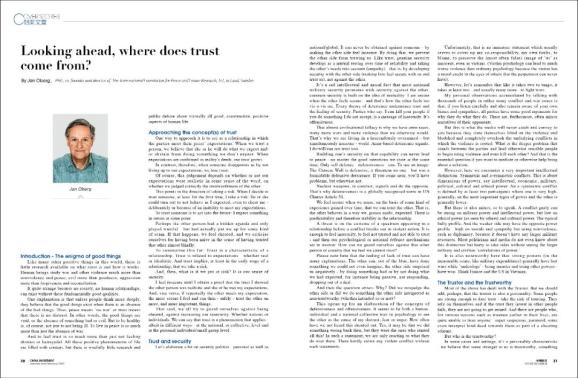 Jan Oberg
PhD , co-founder and director of The Transnational Foundation for Peace and Future Research, TFF, in Lund, Sweden
Introduction - The enigma of good things
Like many other positive things in this world, there is little research available on what trust is and how it works. Human beings study war and other violence much more than nonviolence and peace; evil more than goodness; aggression more than forgiveness and reconciliation.
It quite strange because no society, no human relationships, can exist without these fundamentally good qualities.
One explanation is that unless people think more deeply, they believe that the good things exist when there is an absence of the bad things. Thus, peace means ’no war’ or trust means that there is no distrust. In other words, the good things are void, or the absence of something bad or evil. But to be healthy is, of course, not just to not being ill. To live in peace is so much more than just the absence of war.
And to feel trust is so much more than just not feeling distrust or betrayedal. All these positive phenomenons of life are filled with content, but there is woefully little research and public debate about virtually all good, constructive, positive aspects of human life.
Approaching the concept(s) of trust
One way to approach it is to see as a relationship in which the parties meet their peers’ expectations. When we trust a person, we believe that she or he will do what we expect and/or abstain from doing something we don’t expect. When expectations are confirmed in reality’s deeds, our trust grows.
In contrast, therefore, when someone disappoints us by not living up to our expectations, we lose trust.
Of course, this judgement depends on whether or not our expectations were realistic in some sense of the word, on whether we judged correctly the trustworthiness of the other.
This points in the direction of taking a risk. When I decide to trust someone, at least for the first time, I take a risk: He or she could turn out to not behave as I expected, even to cheat me - deliberately or because of an inability to meet my expectations.
To trust someone is to act into the future: I expect something in return at some point.
Perhaps the other person had a hidden agenda and only played trustful - but had actually put me up for some kind of scam. If that happens, we feel cheated, and we criticise ourselves for having been naive in the sense of having trusted that other almost blindly.
To summarise this far: Trust is a characteristic of a relationship. Trust is related to expectations - whether real or idealistic. And trust implies, at least in the early stage of a relationship, that we take a risk.
And, then, what is it we put at risk? It is our sense of security.
I feel insecure until I obtain a proof that the trust I showed the other person was realistic and she or he met my expectations. And, vice versa, if repeatedly the other meets my expectation, the more secure I feel and can then - safely - trust the other on more, and more important, things.
That said, we all try to guard ourselves against being cheated, against increasing our insecurity. Whether nations or individuals. We can say that trust is a phenomenon that applies - albeit in different ways - at the national, or collective, level and at the personal individual/small group level.
Trust and security
Let’s elaborate a bit on security politics - personal as well as national/global. It can never be obtained against someone - by making the other side feel insecure. By doing that, we prevent the other side from trusting us. Like trust, genuine security develops as a mutual testing over time of reliability and taking the other’s needs into account (empathy) - that is, by developing security with the other side (making him feel secure with us and trust us), not against the other.
It’s a sad intellectual and moral fact that most national military security promotes with security against the other, common security is built on the idea of mutuality: I am secure when the other feels secure - and that’s how the other feels too vis-a-vis me. Every theory of deterrence undermines trust and the feeling of security. Parties who say: I can kill your people if you do something I do not accept, is a message of insecurity. It’s offensivness.
That almost civilisational fallacy is why we have arms races, many more wars and more violence than we otherwise would. That’s why we are living in a horrendously overarmed - but simultaneously insecure - world. Arms-based deterrence signals: I do/will/can not trust you.
Building one’s security on that capability can never lead to peace - no matter the good intentions we state at the same time. Only self-defence - defensiveness - can. To use an image: The Chinese Wall is defensive, it threatens no one - but was a formidable defensive deterrence: If you come near, you’ll have problems, but otherwise not.
Nuclear weapons, in contrast, signals and do the opposite. That’s why defensiveness is a globally recognised norm in UN Charter Article 51.
We feel secure when we sense, on the basis of some kind of experience gained over time, that we can trust the other. That is, the other behaves in a way we, grosso modo, expected. There is predictability and therefore stability in the relationship.
A threat is on the extreme of a spectrum appearing in a relationship before a conflict breaks out in violent action. It is enough to feel insecurity, to feel not trusted and not able to trust - and then our psychological or national defence mechanisms set in motion: How can we guard ourselves against that other person or country that we feel we cannot trust?
Please note here that the feeling of lack of trust can have many explanations. The other can, out of the blue, have done something we could not even imagine; the other side surprised us negatively - by doing something bad or by not doing what we had expected, for instance being passive, not responding, dropping out of a deal.
And then the question arises: Why? Did we misjudge the other side or did we do something the other side interpreted as non-trustworthy (whether intended so or not)?
This opens up for an elaboration of the concepts of defensiveness and offensiveness. It seems to be both a human-individual and a national-collective trait in psychology to see the other as the cause of my distrust, fear or anger. How often have we not heard this shouted out: Yes, it may be that we did something wrong back then, but they were the ones who started all this! In such a statement, we are only reacting to what they do over there. There hardly exists any violent conflict without such statements.
Unfortunately, that is an immature statement which usually serves to cover up my co-responsibility, my own faults, to blame, to preserve the (most often false) image of ’us’ as innocent, even as victims. (Victim psychology can lead to much worse violence than ordinary psychology because the victim has a moral credit in the eyes of others that the perpetrator can never have).
However, let’s remember that like it takes two to tango, it takes at least two - and usually many more - to fight wars.
My personal observations accumulated by talking with thousands of people in rather many conflict and war zones is that, if you listen carefully and also remain aware of your own biases and sympathies, all parties have some good arguments for why they do what they do. There are, furthermore, often mirror narratives of their opponents.
But this is what the media will never catch and convey to you because they stare themselves blind on the violence and blodshed and completely overlook the underlying conflicts in which the violence is rooted: What is the deeper problem that stands between the parties and lead otherwise sensible people to begin using violence and even kill each other? And that is the essential question if you want to mediate or otherwise help bring about a solution.
However, here we encounter a very important intellectual distinction: Symmetric and a-symmetric conflicts. This is about dimensions of power, say intellectual, economic, military, political, cultural and ethical power. An a-symmetric conflict is defined by at least two participants where one is very high, generally, on the most important types of power and the other is generally lower.
But there is also mixes, so to speak. A conflict party can be strong on military power and intellectual power, but low on ethical power (as seen by others) and cultural power. The typical bully profile. And the weaker side may have the opposite power profile - high on morals and sympathy but using nonviolence, such as diplomacy, because it doesn’t have any larger military resources. Most politicians and media do not even know about this distinction but hurry to take sides without seeing the larger military and civilian ’correlations of power.’
It is also noteworthy here that strong powers (in the measurable sense, like military expenditures) generally have lost wars while ’underdogs’ - being smarter and using other powers - have won. Think France and the US in Vietnam.
The Trustor and the Trustworthy
Most of the above has dealt with the Trustor. But we should add, perhaps, that the trustor is also a personality. Some people are strong enough to dare trust - take the risk of trusting. They rely on themselves and if the trust they invest in other people fails, they are not going to get ruined. And there are people who, for various reasons such as traumas earlier in their lives, are quite unable to trust anyone - super-suspicious, paranoid; some even interpret kind deed towards them as part of a cheating scheme.
But who is the trustworthy?
In some cases and settings, it’s a personality characteristic - we believe that some stranger to us is trustworthy, something in the manners, eyes, way of speaking, handshake - whatever - that makes us believe that this person is trustworthy - even though there may be no concrete reason and test to build such a perception on.
And most likely, we’ve all come across someone with some different characteristics and personality traits that did everything else but give us a sense of trustworthiness.
Let’s remember that life teaches us also that, in principle and later on, we could have made wrong or unfair judgement. Perceptions may change over time - the trustworthy turned out to be a charmer, the untrustworthy was just a somewhat unconventional, strange character, but turned out to become a trusted friend for life.
Being trustworthy, of course, is not only a matter of personality or experience. It has also a professional dimension.
We have a lot of ”automatic” trust in, say, pilots, doctors, priests and psychiatrists - those whose professional task is to deal with or heal us human beings.
Then there is the contrasting side: in many parts of the world, people have much less trust in politicians, auto mechanics or marketing firms. And there are sub-societies where internal trust is everything - such as various sectarian societies, Hell’s Angles, mafia organisations and those who perform dangerous circus acts. One would assume also that there is a very high level of trust in a symphony orchestra - the conductor trusting the competence and obedience of the members as well as the the musicians trusting that if they follow the conductor, the collective result will be better than if everybody plays his or her own tune.
There is much more to be said about trust and related matters. Let’s now explore how at least some of this can be transferred to the level of global co-existence.
Trust in a global perspectivet
An interesting opinion poll - the ”Edelman Trust Barometer” - is produced annually by the - somewhat unconventional - Edelman communications firm in the United States. Among many results, it shows that the Chinese people rank as # 1 when it comes to trust in their government - 91% and increasing steadily the last few years. This compares with 39% of the Americans and similar low levels in many European countries.
This global survey is based on more than 36,000 respondents in 28 countries each respondent participating in a 30-minute online interview. The report is published in January and covers a range of indicators of trust among business, media, government and NGOs.
The Edelman team formulated the main conclusions in 2022 under this headline:
”Vicious cycle of distrust fueled by government and media
We find a world ensnared in a vicious cycle of distrust, fueled by a growing lack of faith in media and government. Through disinformation and division, these two institutions are feeding the cycle and exploiting it for commercial and political gain. 48% view government and 46% the media as divisive forces in society.”
One must wonder how long time would such deliberately manufactured distrust - fake and omission and plain lies - could produce any type of gain?
CEO Richard Edelman reflects on the - mind-boggling - role of fake news here - where you can read that ”There are now almost as many fake news local media sites in the U.S. than actual local daily newspapers.”
One would believe that Edelman’s 2022 Barometer should be a shocking finding to the world, not the least those parts of it that considers themselves to be democracies in contrast to autocracies. But as far as we’ve been able to investigate, it did not make headlines or create much debate - at least not as much as some news about sports or celebrities.
Now, Edelman is a private communications corporation with some 6000 employees around the world, it is not a research institute per se. But it does have a research institute and learning laboratory for trust, and it publishes data-driven insights around trust that inform leadership, strategy, policy and sustained action across institutions.
Strangely, we’ve not been able to find on its site how Edelman actually defines trust or what methods it uses to operationalise such a definition into the set of question put to people around the world. And some of its publications are not exactly free of political biases. But let’s leave it at that for now.
In an Edelman anthology on ”Restoring Trust in a Fractured World,” we’ve found a couple of interesting insights. One is by Gargee Ghosh who says: ”So how can cooperation work at a time when distrust is the default? Well, history suggests that some of the most important steps forward in global cooperation came even at moments when trust was difficult to come by, and that these joint actions helped rebuild trust. And why does cooperation work even at moments when animosity runs high? In short, cooperation can work because it delivers results and is built around mutual self-interest.”
Another one is made by Parag Khanna who argues that the West could learn from the fact that Eastern governments generally enjoy higher levels of trust by their citizens than those in the West. That there is something interesting about what he calls Asian values, namely ”an almost scientific approach to governance, one that applies trial and error methods to deliver utilitarian outcome.”
Khanna then argues that there are basically three principles underlying that Asian trust: a) technocratic government (except China) and a citizenry not afraid of tossing under-performing governments; b) a strong belief in the government’s essential role in driving long-term strategic planning - which is a necessary corrective against over-reliance on free-market orthodoxy, and c) taking a cautious and incremental approach towards societal change, one that places a premium on maintaining social harmony. This too, he says, is a natural corrective to some of the excesses of the me-first, liberal ideology that prevails in much of the West. It’s an attitude rooted in the region’s history.
I tend to believe that these are actually essentials for building trust between people and their governments and also explains to some extent why China ranks so high on the Trust Barometer.
And it is indeed time for low-trust countries to read the writing on the wall, re-think trust and to do things differently. But that implies a willingness to learn from others, a humble awareness that ’we can still improve,’ and a capacity to adapt and to integrate other, perhaps even non-Western, values. It’s no more strange - or difficult - than it has been for non-Western societies to infuse some Western values and ways of thinking into their societies and culture and make something new out of the mix.
That sort of long-term melting processes surely also contribute to trust: You have something good - but we dont like all of it - and we can use that in our way! And we may have something good too - among aspects you may not like with us - and perhaps you can use that. In short, a little us in you and a little you in us!
Such a view is preconditioned on an ability to look at others in a differentiated manner rather than painting everything about the other in black. It also requires a sense that there is something we can do better, rather than a sense that we are the top of civilisation and our only task is to teach other lessons and mould them into copies of ourselves.
One may certainly ask today whether the West - the Occidental culture - has such an ability or it will decline because it lacks it.
That latter sort of attitude makes for anything but trust - it makes for distrust and vertical subordination, win/lose rather than horisontality, mutuality, commonality and win/win.
How trust can be restored or built - and why not say ’I am sorry’?
Where would trust then come from ? If lost how could it be restored? As stated in the introduction, truth is, I believe, that we know where little about it. However, given this author’s background as an expert in conflict (Diagnosis, Prognosis and Treatment/Solution), I would venture that (re)building of trust is close to conflict-resolution, shaping a new vision that permits the former conflicting parties to accommodate and feel safe. I would argue that it is close to reconciliation and forgiveness. Why?
Because, underlying distrust - as well as various kinds of violence - is always one of more conflicts. Distrust and violence are merely symptoms of something deeper - like the pain in the human body is not the problem and cannot be solved in a genuine sense by painkillers, but only by asking: What is the roots of the pain? What are the roots of the violence - or the distrust?
That’s the Diagnosis, then comes Prognosis - what if this continues and escalates, what if we do this or that about it and what if we do nothing? And then comes Treatment: Some kind of intervention with the parties and with the structure of the relationship between them - and changing attitudes, behaviours and conflict issues to such an extent that the same conflict - distrust - will not come back again. If it does, the conflict has not been dealt properly with and trust could not be built.
Sometimes a war or other violence have to rage - but at some point, the parties will have to address what it is that made them take to the violence in the first place. The same process, one can argue, applies to trust: We can achieve nothing and will harm each other and ourselves in the long run unless we stop to think and address why we do not trust each other. And then do something new that can re-build trust.
One sure way to rebuild trust is to say: I am sorry - sorry, for example, for being too suspicious of you or for trying to manipulate, or fool, you. Even for my threatening you. I should not have done that. Human beings can say: I am sorry for what I said or did - I truly repent and ask your forgiveness.
It’s a huge problem that there is no such mechanism at the state level. There do exist cases when a intellectually and ethically towering politicians has had the civil courage to say: I am sorry. - In 1970, then German chancellor, Willy Brandt, spontaneously fell to his knees at the war memorial in Warsaw to apologise for Nazi-Germany’s crimes.
Undoubtedly, that physical, symbolic deed created a huge opening for forgiveness and reconciliation. And for trust - trust on which to build a new more trust- and peaceful Europe.
Sadly, however, most politicians do not have such a human scope. It requires a genuine personality and a refusal to just play the leader’s role. It requires taking off the tough statesman role and becoming yourself. Brandt, by the way, had himself been a refugee from Nazi-Germany in Norway. He understood suffering and could empathise with those who suffered.
Playing tough and self-righteous, showing no willingness to recognise one’s own wrongdoings but, instead, go about (often militarist) business as usual - being a real Man and not showing emotions - seems, strangely and regrettably, still to be expected of national leaders - or what defines political leadership in everyday life.
This fact may one day cause a nuclear annihilation: Leaders playing it like a ’chicken game’ and not giving in to any ’soft’ policies.
Danish philosopher Piet Hein has formulated it brilliantly:
The noble art of Losing Face
may one day save the Human Race
and turn into eternal merit
what weaker minds would call disgrace.
The general inability of national leaders’ to say sorry - or ’lose face’ - points to the importance of building people-to-people trust instead. Based on my own work with reconciliation and forgiveness in war zones, I believe more in building trust at that level, from the bottom-up, and then let it inspire leaders. It’s easier for a top leader to reach out and say: My people wants to re-build trust so that’s what I am now working to do with you - than moving alone.
One more aspect of trust-building is appropriate here: Trust and distrust work differently in symmetric and a-symmetric relationships. Ceteris paribus, it is easier for the big and strong to say ’I trust you’ to the smaller and weaker party.
And vice versa - the weaker side who says ’I trust you’ may lose everything simply because that side has a larger dependence spectrum - trusting someone completely can be devastating if everything is put at risk.
Most likely, the loss from being cheated is smaller to the topdog than to the underdog. In contrast, in symmetric relationships, the risk one takes is about the same as that which the other side takes.
At the end of the day, one can see trust - and the willingness to trust - as an indicator or relative power. A-symmetric parties may pay very different prices the day it turns out that the other could not be trusted.
In the best of cases, mutual trust is a win/win. But we must add one quality to that: Not a win/win where the strong wins 90% and the weak 10%. Trust is about moving as close to 50/50 as possible in symmetric relations and doing the inverse in a-symmetric relations: The strong party may build trust effectively by letting the weaker get 60% or more and obtaining only a smaller ’win’ for itself.
Trust and culture
How is trust - and its definitions - influenced by cultures? How does different ways of thinking conceive of trust?
I think it is fair to say that people’s perception of trust has a lot in common across cultures. But the role of trust may differ. For instance, David de Cremer argues in the article ”Understanding Trust, in China and the West” that the Western concept is sometimes described as being fast or primary - you build trust while you go, so to speak. If cooperative efforts go well, trust will develop.
In contrast to that, he maintains, it seems that the Chinese conception of trust is more time-consuming and fundamental, and it is only after you’ve build trust between parties, that the Chinese is ready to enter into negotiations and make deals.
If this is so, it is interesting for at least two reasons: The Chinese want to build a basis for cooperation first - before cooperating. This means that what the West does prior to dealings with China will influence later chances for building cooperative relations.
Further it means that the Western blend of quick action - ”let’s get things done now!” - with the classical combination of mixing deterrence/offensive statements or actions with also signalling a will to cooperate selectively simply won’t work. Because it is culturally insensitive. The comparative advantage is on China’s side here as, generally, the Chinese know much more about the West than vice versa.
The Transnational Foundation’s publication from 2021 about the US Cold War policy against China - ”Behind the Smokescreen. An Analysis of the West’s China Destructive Cold War Agenda And Why It Must Stop” - regrettably is one long documentation on how to build distrust.
In lieu of a conclusion
Time for a summary - but not a conclusion; much more research and experiments are needed:
• Little is actually known researchwise about trust; the world must experiment with it to the best of its abilities, because we cannot do without it.
• Trust is a relational concept that implies taking risks and therefore also stimulates defence and security mechanisms and thinking.
• While it is a relational phenomenon, it depends to a large extent on the parties ’personality’ and life experience.
• Trust depends very much on whether we talk about a symmtric or a-symmtric relationship.
• There is a considerable difference between building trust for the first time and restoring trust after it has broken down. The latter comes close to conflit-resolution, forgiveness and reconciliation.
• The human experience of trust is probably rather similar across the cultural spectrum but the place, or role, of trust-building surely varies according to ways of thinking in different cultures.
• Trust takes time - and like virtually every positive value (peace, freedom, truth), it takes time to build it and only a short time and perhaps even just a single wrong deed to ruin it.
• Trust can be seen as a synergetic: relations built on 100% fundamental, solid trust can achieve positive results a 100% more effectively.
• Sadly, we live in an era where there seems to be a rapidly decreasing level of trust throughout society and in governments and the media, particularly in the Western world. It’s high time to identify the causes behind because no society can live for long without trust among its citizens.
Some recommended readings
• The Stanford Encyclopedia of Philosophy - on Trust
• Psychology Today - Trust
• The Philosophy of Trust - Key findings
• Notre Dame Philosophical Reviews - The Philosophy of Trust
• The Open University - On Trust and Philosophy
• The Marginalian - Collection of articles on Trust
• David de Cremer
Understanding Trust, in China and the West
Harvard Business Review
• Steve Farber
Understanding Chinese Trust
• Learn Chinese Weekly
The Chinese word for trust
• Goodreads
Quotes on trust
Translator | Wang Xiaobo
Design | Demi
 本文刊于《中国投资》2023年1月号
版权所有,侵权必究
欢迎个人分享,媒体转载请回复本微信号获得许可
《中国投资》杂志创办自1985年,由国家发改委主管,国家发改委投资研究所、中国国际工程咨询有限公司主办,是我国投资领域唯一的中央级刊物,业界最早专注于投资领域趋势报道的核心期刊。创刊三十多年以来,杂志以全球视角看中国投资,涵盖宏观经济、行业分析和企业投资案例,同时以全球市场为坐标,聚焦特定国家、地区和重大国际趋势,目前已经成为世界各国政府官员、各类投资机构、专家学者、企业家以及记者媒体的专业对话平台。
《中国投资》杂志每期覆盖包括上市公司在内的200多家央企国企和10000多家中国民营企业、1000多家中央与地方政府决策部门和机构、1000多家行业协会和商会、300多家主要金融机构等,是了解宏观经济环境、行业趋势前景和企业投资案例的重要参考。
China Investment, founded in 1985, is a monthly under the supervision of National Development and Reform Commission (NDRC) China’s macro-economic management agency, It’s jointly operated by Investment Research Institute under NDRC, China International Engineering Consulting Corporation. Enjoying an exclusive position under the central government, China Investment is the core journal which started the earliest among similar magazines to focus on the investment trend. Over the past 30-plus years, China Investment has been in line with theglobal market as its fundamental coordinate with a strategic focus on specific countries and regional markets and those major international propensities. China Investment is a key dialogue platform for officials from different countries, investment agencies, experts and scholars, business people and journalists.
原标题:《Looking ahead, where does trust come from》
本文为澎湃号作者或机构在澎湃新闻上传并发布,仅代表该作者或机构观点,不代表澎湃新闻的观点或立场,澎湃新闻仅提供信息发布平台。申请澎湃号请用电脑访问http://renzheng.thepaper.cn。







- 报料热线: 021-962866
- 报料邮箱: news@thepaper.cn
互联网新闻信息服务许可证:31120170006
增值电信业务经营许可证:沪B2-2017116
© 2014-2026 上海东方报业有限公司