
- +1
Indonesia: Global Promising Land for Investment
原创 Oratmangun 中国投资参考
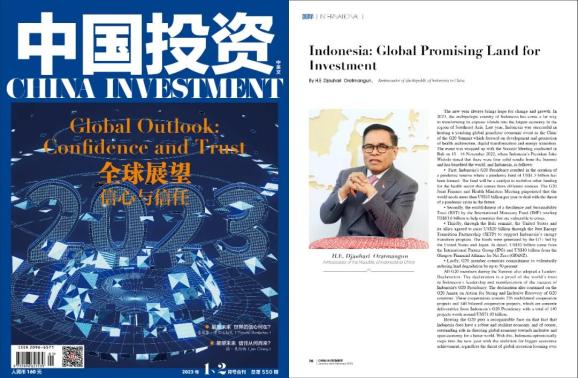 H.E. Djauhari Oratmangun
Ambassador of the Republic of Indonesia to China
The new year always brings hope for change and growth. In 2023, the archipelagic country of Indonesia has come a far way in transforming its copious islands into the largest economy in the region of Southeast Asia. Last year, Indonesia was successful in hosting a yearlong global grandiose economic event as the Chair of the G20 Summit which focused on development and promotion of health architecture, digital transformation and energy transition. The event was wrapped up with the Summit Meeting conducted in Bali on 15 - 16 November 2022, where Indonesia’s President Joko Widodo stated that there were four solid results from the Summit and has benefited the world, and Indonesia, as follows:
• First, Indonesia’s G20 Presidency resulted in the creation of a pandemic reserve where a pandemic fund of US$1.5 billion has been formed. The fund will be a catalyst to mobilize other funding for the health sector that comes from different sources. The G20 Joint Finance and Health Ministers Meeting pinpointed that the world needs more than US$10 billion per year to deal with the threat of a pandemic crisis in the future.
• Secondly, the establishment of a Resilience and Sustainability Trust (RST) by the International Monetary Fund (IMF) totaling US$81.6 billion to help countries that are vulnerable to crises.
• Thirdly, through the Bali summit, the United States and its allies agreed to raise US$20 billion through the Just Energy Transition Partnership (JETP) to support Indonesia’s energy transition program. The funds were generated by the G7+ led by the United States and Japan. In detail, US$10 billion came from the International Partner Group (IPG) and US$10 billion from the Glasgow Financial Alliance for Net Zero (GFANZ).
• Lastly, G20 member countries commitment to voluntarily reducing land degradation by up to 50 percent.
All G20 members during the Summit also adopted a Leaders' Declaration. The declaration is a proof of the world’s trust in Indonesia’s leadership and manifestation of the success of Indonesia's G20 Presidency. The declaration also contained on the G20 Annex on Action for Strong and Inclusive Recovery of G20 countries. These cooperations contain 226 multilateral cooperation projects and 140 bilateral cooperation projects, which are concrete deliverables from Indonesia’s G20 Presidency with a total of 140 projects worth around US$71.49 billion.
Hosting the G20 puts a recognizable face on that fact that Indonesia does have a robust and resilient economy, and of course, outstanding role in directing global economy towards inclusive and open economy for a better world. With this, Indonesia optimistically steps into the new year with the ambition for bigger economic achievement, regardless the threat of global recession looming over all the countries.
According to the World Bank release in December 2022, Indonesia is projected to experience a strong growth of 5.2 percent in 2022. The positive figure is attributed to the post-COVID-19 reopening of the economy and commodity price rises, with growth expected to be maintained on average at 4.9 percent over the medium term, year of 2023 to 2025. Indonesia’s economic conditions have remained stable amid global turbulence and shocks in 2022 in which inflation had picked up, reaching 5.7 percent year-on-year in October, and food prices increased by 7.9 percent year-on-year in September. However, Inflation is projected to peak in 2023 at 4.5 percent and is expected to remain at Bank Indonesia’s upper bound target at an average of 3.5 percent over 2024 and 2025.
Indonesian Economic Overview in 2023
President Widodo underlined that global conditions are replete with uncertainty and difficult to predict in 2023, that is why Indonesia must remain cautious and vigilant without losing optimism. With respect to policymaking, fiscal-monetary synergy must be constantly strengthened to ensure that national economic policy provides enormous benefits to the people and the country in terms of fostering national economic resilience and revival. In other words, it is worth highlighting that optimism for the economic recovery must be strengthened while remaining vigilant of global spillovers and uncertainty, including the risk of stagflation (economic moderation and high inflation) and even resflation (economic recession and high inflation).
Despite persistent global economic turmoil, the Indonesian economy remains resilient with a promising outlook. The Central Bank of Indonesia projects solid national economic growth in Indonesia in 2023 between the range of 4.5 - 5.3% and then in 2024 accelerating to 4.7 - 5.5%, strengthened by private consumption, investment and positive export performance against a backdrop of global economic moderation.
Consumer Price Index (CPI) inflation is projected to track a downward trend and return to the 3% - 1% target in 2023 and 2.5% - 1% in 2024, with core inflation expected to return the target earlier, namely in the first half of 2023, in line with controlled imported inflation, a stable rupiah as well as a front-loaded, pre-emptive and forward-looking monetary policy response.
Synergy and innovation become the key to the economic outlook for Indonesia in 2023 and 2024, consequently maintaining economic resilience and revival. Meanwhile, digital economy and finance will continue to increase in 2023 and 2024, with the value of e-commerce transactions expected to reach IDR 572 trillion (eq. USD 36.8 billion) and IDR 689 trillion (eq. USD 44.4 billion) respectively, electronic money transactions totalling IDR 508 trillion (eq. USD 32.7 billion) and IDR 640 trillion (eq. USD 41.2 billion) and digital banking transactions predicted to exceed IDR 67 thousand trillion (eq. 4.32 trillion USD) and IDR 87 thousand trillion (eq. USD 5.6 trillion).
Potential sectors will continue to be encouraged so that investment realization can meet this year’s target. These sectors are notably the primary metal and value-added industries such as nickel and copper. The industries mentioned above have seen exponential growth over the past three years. Therefore, they will receive extra incentives and support to realize investments to keep the economic growth steady above 5% in 2023 and meet their goals.
Although the prediction for this year is that the global economy will experience a general slowdown, Indonesian Minister of Investment Bahlil Lahadalia showed his optimism that Indonesia can meet the target of IDR 1,400 trillion (eq. USD 92 billion) through joint efforts. It is a challenge to overcome by carrying out responsibilities with optimal efficiency.
Indonesia to Launch Investment Opportunity Map (PPI)
The government sets a target to reach national economic growth of 2023 to be 5.3%. This number is much higher than the global economy’s outlook which predicts the number will be around 2.2% to 2.7%. Apart from this, the government also plans to increase national food reserves by paying attention to the availability of various staple food commodities. Furthermore, Indonesia also plans to accelerate investment in developing health architecture, digital infrastructure, renewable energy plants, nickel smelting, electronic vehicles and battery in their upstream and downstream process.
By the end of 2022, the government through the Ministry of Investment/Indonesia Investment Coordinating Board (BKPM) has publicly released the Investment Opportunity Map (PPI) for strategic priority projects in 13 provinces. The PPI will focus on 22 profiles of sustainable investment projects spread across the 13 provinces of North Sumatra, South Sumatra, Riau Islands, West Java, Banten, East Java, West Kalimantan, East Kalimantan, West Nusa Tenggara (NTB), East Nusa Tenggara (NTT), South Sulawesi, Gorontalo, and Maluku. The 22 investment project profiles included in the 2022 PPI, comprised 11 natural resources-based projects and 11 manufacturing industry-based projects with total investment value of IDR 37.32 trillion (eq. USD 2.47 billion).
On top of that, Minister Bahlil instructed the ministry to ensure a clear path for investors to Indonesia and highlighted that the PPI must become investment opportunity profiles in the regions that provide comprehensive and detailed pictures to potential investors. The PPI can be easily accessible online through a website and designated to be an instrument of the government's presence in facilitating the entry of investment into Indonesia. The website is similar to that of a matchmaking agency in which interested parties could obtain a comprehensive information on the existing investment projects, contact the project owners directly and further discuss the details.
Minister Bahlil reiterated that through the PPI, the government will focus on developing New and Renewable Energy (NRE)-based industries that are environmentally friendly, so that the products would have competitive value in the global business. The government also offers investment in natural resources-based projects which include clusters in plantations, horticulture, food crops, livestock, fisheries, and energy.
Minister Bahlil added that projects based on the manufacturing industry comprised clusters of the chemical industry, miscellaneous industry, metal, machinery, transportation equipment, and electronics industry are also welcomed. The investment projects are expected to directly contribute to the achievement of the Sustainable Development Goals (SDGs), particularly for poverty alleviation, job creation, and economic growth, as well as for reducing economic inequality.
Indonesia's New Capital City (IKN): Smart, Sustainable, Resilient
Besides the above-mentioned 22 investment projects, Indonesia is set to build the New Capital City of Indonesia (Ibu Kota Nusantara - IKN) which is planned to be inaugurated in August 2024 along with the celebration of Indonesia’s national day. The state capital is designed and expected to be a smart, sustainable, and resilient city. Technology, as an enabler of smart city development, will be utilized as a solution to tackle urban problems. For the well-being of societies, technological innovation will surely contribute to the development of a new model of social, economic, and environmental growth to make the capital city more modern and sustainable.
The development of IKN represents both the nation’s identity and a tremendous opportunity to boost economic development and modernize infrastructure. IKN development will serve as the backbone of Indonesian economy generation, as it provides social and economic benefits to society. The development of the modern city of IKN will enable competitive advantages in the global economy and contribute to Indonesia’s economic and social growth. The master plan of IKN, through 1 MPP (1 Map-1 Plan-1 Policy), reflects the latest state-of-the art technology, focusing on innovation and creating an ecosystem that is expected to improve citizens’ quality of life.
IKN development also aims to produce a resilient and sustainable city by improving city services from transportation, energy, and water resources to waste disposal and health services. The establishment of the smart city of IKN can improve the city’s ability to use natural resources efficiently, make public transportation more attractive, and provide data to decision makers for the appropriate allocation of resources.
What makes IKN interesting is the fact that the three main principles for the development of IKN will be the combination of forest city, sponge city, and smart city concepts. In addition, Eight key performance indicators have been set up to achieve this development goal, as follows: building a city in tune with nature, easily accessed and connected, circular, resilient, safe, affordable, technologically friendly, and particularly, providing business opportunities for everyone.
The authority of IKN frequently stated that IKN is a green city with an area of 256,142 hectares, where 65% of the area is dedicated to tropical forest, 10% to parks and food production, and the rest as urban areas with various zones of mixed use and neighborhoods. The green city will make use of abundant renewable resources, from green energy to urban air mobility. This means that the city has the potential to be carbon neutral, absorbing more CO2 than it emits. A sustainable approach is important to ensure the fulfillment of future needs by maintaining the ongoing viability of resources. In this sense, the smart city of IKN will contribute to the formation of a high-quality, healthy, and regenerative built environment with an overall positive impact on all of IKN's citizens’ lives.
The use of digital technology, such as Artificial Intelligence (AI), Internet of Things (IoT), Big Data and various latest technology tools will serve as the city’s development and operational system. Technology development and innovation will play a significant role, not only in developing a smart city as one of the solutions to urban challenges but also in creating a new model of future digitally connected urban management that is economically feasible, socially desirable, and environmentally sustainable. This way, IKN will have autonomous and electric vehicles as one mode of public transportation, offering mobility-as-a-service to citizens.
Indonesia's New Capital City (IKN): Latest Progress of Investment Development
IKN is expected to focus on innovation and entrepreneurial environments to cultivate growth and attract investment to boost economic performance, as well as to improve citizens’ quality of life. Regional development will be facilitated to represent the nation’s progress and to serve as a catalyst for building and spreading centers of productivity and economic activity. This way, IKN is open to everyone, such as investors, manufacturers, researchers, thinkers, and supporters of innovation, to develop city ecosystems that are green, inclusive, smart, resilient, and sustainable. It will be an inclusive global city for all.
In this regard, IKN is in need of investments in green technology, safer materials, and technological advances for utilizing renewable energy resources, building urban water systems and sustainable public infrastructure, and producing environmentally friendly products that will provide pathways through which technology will significantly contribute to sustainable IKN development.
The government then conducted a number of market sounding activities to attract investment for accelerating the development of a complete ecosystem in the Central Government Core Area (KIPP). It is reported that during the market sounding with Indonesian President conducted in early January 2023, land requests from the investors have reached 1,693 hectares or 44 times more than what it is offered.
Meanwhile, the ministry also noted that interest to invest in IKN is enormously increasing time by time in which a great deal of investors were constantly contacting the ministry. They are reportedly interested in investing in various sectors, including 15 investors interested in the education sector, 18 investors interested in infrastructure and utilities, 9 investors interested in mixed use and commercial, 9 investors interested in the housing sector, 6 investors interested in consulting services, 5 investors are interested in the health sector, 3 investors are interested in the private and state-owned office sector, 2 investors are interested in government offices, and 4 investors are interested in the technology sector.
Besides KIPP areas, the government also offers investment opportunities for tourism, economic center, education, and health center. In a nutshell, Indonesian President has given instruction to open investment opportunities extensively, so that many investors with wide range of sectors could join and IKN area could be built immediately.
Indonesia and China's Economic Relations
In 2022, according to the date released by the General Administration of Customs of the People's Republic of China (GACC) during the period of January–December 2022, total trade between Indonesia and China reached USD 149.08 billion in value. This figure is an increase of 19.76% from the same period of the previous year. China remains Indonesia's biggest trading partner for years and Indonesia becomes China's 12th biggest trading partner and ranks China's third biggest trading partner among ASEAN countries.
In trade, the food and energy sector have become important focus of Indonesia-China trade relations. China views Indonesia as an important contributor to its food security endeavors, while the latter views the former as a market for its agricultural products. This will increase in the coming years, especially with the recent decision by China to reopen itself for exports of porang from Indonesia, China’s commitment to buy 2.5 million tons of crude palm oil (CPO) and its derivatives from Indonesia and Indonesia’s decision to finally ratify the China-backed Regional Comprehensive Economic Partnership (RCEP).
Besides trade, according to Indonesia's Ministry of Investment, China's investment realization in Indonesia during January- December 2022 was recorded at USD 8.2 billion, increasing 156.25% from the same period of the previous year. With this increase, China's investment is now in second place, behind Singapore.
In September 2021, Central Banks between Indonesia and China agreed to implement Settlement of Local Currency (LCS) Rupiah and RMB for settling bilateral transactions by business actors in Indonesia and in China using local currencies. In this case, Rupiah and RMB in the context of settlement of trade and direct investment transactions can only be done through Appointed Cross Currency Dealer (ACCD) Bank which are 14 Indonesian banks and 8 Chinese banks.
The growing business relations have led Indonesia and China to renew their Bilateral Currency Swap Arrangement (BCSA) on 21 January 2022 in which the exchange of local currencies can be done up to USD 38.8 billion equivalent to promote the use of RMB and Rupiah in both economic transaction either trade or investment.
Major cooperation between Indonesia and China includes Indonesia's national top priority projects, such as the development of the Jakarta-Bandung high-speed railway project and the “Two Countries Twin Parks” program, development of Kura Kura island in Bali as the center of R&D for information technology, an electric vehicle or lithium battery factory in Morowali, the Jatigede dam, the Medan-Kualanamu highway, the Kuala Tanjung port and so on. Further, both countries are signatories to the Regional Comprehensive Economic Partnership (RCEP). This reflects the highly synergized connectivity between the China-proposed Belt and Road Initiative (BRI) and Indonesia’s own connectivity concept called 'Global Maritime Fulcrum' (GMF).
Last year, both countries' ties have also been strengthened through various high-level exchanges. One of the highlights was Indonesian President’s visit to Beijing in July, which was the first visit of foreign leader since the Beijing Olympics early in the year. In the visit, both countries signed seven agreements such as on synergizing Indonesia’s Global Maritime Fulcrum (GMF) initiative and the Belt and Road Initiatives (BRI); on the development of vaccines and genomic ; on green development; on maritime cooperation; on the export of Indonesia’s pineapples; on information exchanges on customs violations; and on information technology and cybersecurity.
The reciprocal visit was also conducted by Chinese President's visit to Bali, Indonesia for the G20 Summit, in which on the sidelines of this global economic majestic event, both leaders conducted bilateral meeting. The meeting also became another platform for Indonesia and China to strengthen their cooperation on which both sides signed an agreement on renewing Bilateral Economic and Trade Cooperation (BETC), which is the legal framework for future Indonesia-China economic cooperation. Tapping into this event, both also signed other MoUs to align the GMF and the BRI; on the development of conservation, research and innovation on traditional medicines; on vocational training on industry; on digital economy; and on trade. Apart from that, both leaders also took the opportunity to witness the trial run of the Jakarta-Bandung high-speed rail and shared their hope that the train could operate by June 2023.
Looking ahead, based on prevailing close and friendly relations, Indonesia-China's ties will further grow to new heights. As China’s borders returned to normal and entered the post-pandemic era in the beginning of 2023, we can set an optimistic high hope that the relations on various sectors, especially in the investment and trade sectors will be significantly boosted in the following years.
Translator | Wang Xiaobo
Design | Demi
 本文刊于《中国投资》2023年1月号
版权所有,侵权必究
欢迎个人分享,媒体转载请回复本微信号获得许可
《中国投资》杂志创办自1985年,由国家发改委主管,国家发改委投资研究所、中国国际工程咨询有限公司主办,是我国投资领域唯一的中央级刊物,业界最早专注于投资领域趋势报道的核心期刊。创刊三十多年以来,杂志以全球视角看中国投资,涵盖宏观经济、行业分析和企业投资案例,同时以全球市场为坐标,聚焦特定国家、地区和重大国际趋势,目前已经成为世界各国政府官员、各类投资机构、专家学者、企业家以及记者媒体的专业对话平台。
《中国投资》杂志每期覆盖包括上市公司在内的200多家央企国企和10000多家中国民营企业、1000多家中央与地方政府决策部门和机构、1000多家行业协会和商会、300多家主要金融机构等,是了解宏观经济环境、行业趋势前景和企业投资案例的重要参考。
China Investment, founded in 1985, is a monthly under the supervision of National Development and Reform Commission (NDRC) China’s macro-economic management agency, It’s jointly operated by Investment Research Institute under NDRC, China International Engineering Consulting Corporation. Enjoying an exclusive position under the central government, China Investment is the core journal which started the earliest among similar magazines to focus on the investment trend. Over the past 30-plus years, China Investment has been in line with theglobal market as its fundamental coordinate with a strategic focus on specific countries and regional markets and those major international propensities. China Investment is a key dialogue platform for officials from different countries, investment agencies, experts and scholars, business people and journalists.
原标题:《Indonesia: Global Promising Land for Investment》
本文为澎湃号作者或机构在澎湃新闻上传并发布,仅代表该作者或机构观点,不代表澎湃新闻的观点或立场,澎湃新闻仅提供信息发布平台。申请澎湃号请用电脑访问http://renzheng.thepaper.cn。







- 报料热线: 021-962866
- 报料邮箱: news@thepaper.cn
互联网新闻信息服务许可证:31120170006
增值电信业务经营许可证:沪B2-2017116
© 2014-2026 上海东方报业有限公司