
- +1
China's AI Labs Are Betting the Future Is Open – And Kimi K3 Shows Why
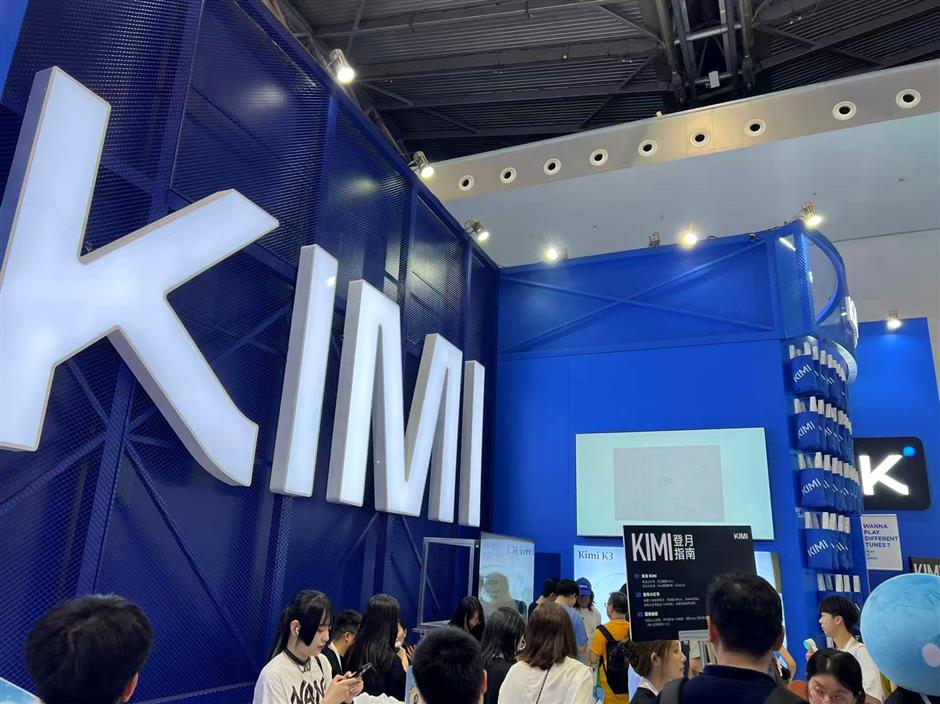
Moonshot booth at the 2026 World Artificial Intelligence Conference in Shanghai. Zhu Shenshen / China Biz Buzz
The next phase of AI competition may not be just about building the smartest models, but about building the largest ecosystems around them.
At the ongoing 2026 World Artificial Intelligence Conference in Shanghai, the Moonshot AI's booth was surprisingly low-key for a company that had just achieved something few AI labs anywhere have managed: the world's largest open-weight frontier model.
This week, Moonshot AI released Kimi K3, a 2.8-trillion-parameter model. It features a 1-million-token context window, native multimodal capabilities and a new architecture called Kimi Delta Attention, designed to make inference at that scale more economically viable.
Without architectural innovations like this, deploying models of this size would become significantly more expensive and challenging. Parameters are the learned values within a machine-learning model that determine how it maps inputs to outputs.
Moonshot, which is backed by Alibaba and Tencent, said Kimi K3 is the world's first open-weight model to approach the 3-trillion-parameter mark and is designed for advanced reasoning, long-horizon coding and knowledge work.
Its release follows the unveiling of GLM-5.2, a 744-billion-parameter open-weight model from Zhipu (Z.ai), which Reuters noted "narrowly trailed leading closed-source models" from the top US firms on benchmark tests. China's MiniMax is also developing its own 2.7-trillion-parameter model.
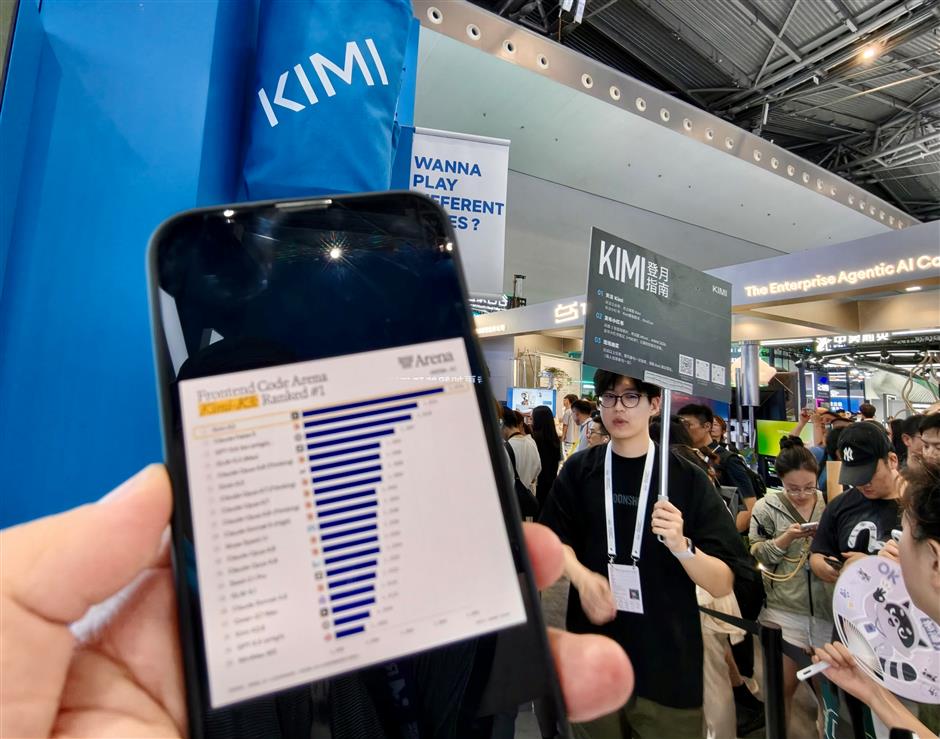
On Arena.ai's Frontend Code Arena leaderboard, Kimi K3 currently ranks No. 1 among tested models, ahead of Claude Fable 5, GPT-5.6, GLM-5.2 and Claude Opus 4.8. While a single benchmark cannot determine overall frontier AI leadership, the result sends an important signal: An open-weight Chinese model is now competing at the top tier of coding benchmarks alongside leading proprietary systems.
Like every major release since Kimi K2 last year, K3 is open-weight, meaning its core model weights are available for developers and researchers to download, run and build upon.
That is where the bigger story begins.
Zhu Shenshen / China Biz Buzz
The strategy behind China's open AI push
Moonshot's success reflects a broader shift across China's AI industry.
Many of China's leading foundation-model developers – including DeepSeek, Alibaba's Qwen, Zhipu's GLM and Moonshot's Kimi – are embracing openness as a core strategy. While their licensing approaches differ, they share a common belief: Frontier AI creates more value when developers, researchers, startups and companies can build on top of it.
Open weights are one expression of a broader philosophy that differs from the dominant approach among many US frontier AI companies, where models from OpenAI, Anthropic and Google largely remain proprietary and are primarily accessed through APIs. Elon Musk's xAI's Grok early on transitioned out of open-weight.
Meta's Llama was once the major US exception, publishing open weights at significant scale. That changed in April, when Meta pivoted to Muse Spark, its first fully closed model, citing concerns including unauthorized use of Llama's architecture by other labs. Even that American holdout for openness has moved toward the closed side. The difference isn't simply about licensing. It's about where each ecosystem believes long-term value will be created.
The culture behind the strategy
Moonshot's commitment to openness also reflects something about the company's culture.
Two of its four founders, Tsinghua University graduates Yang Zhilin and Zhou Xinyu, played in a campus rock band together as students. The company's Chinese name, Dark Side of the Moon (月之暗面), is a tribute to Yang's favorite Pink Floyd album, and Moonshot was reportedly launched on the album's 50th anniversary. Meeting rooms at the company's Beijing headquarters are named after legendary rock bands.
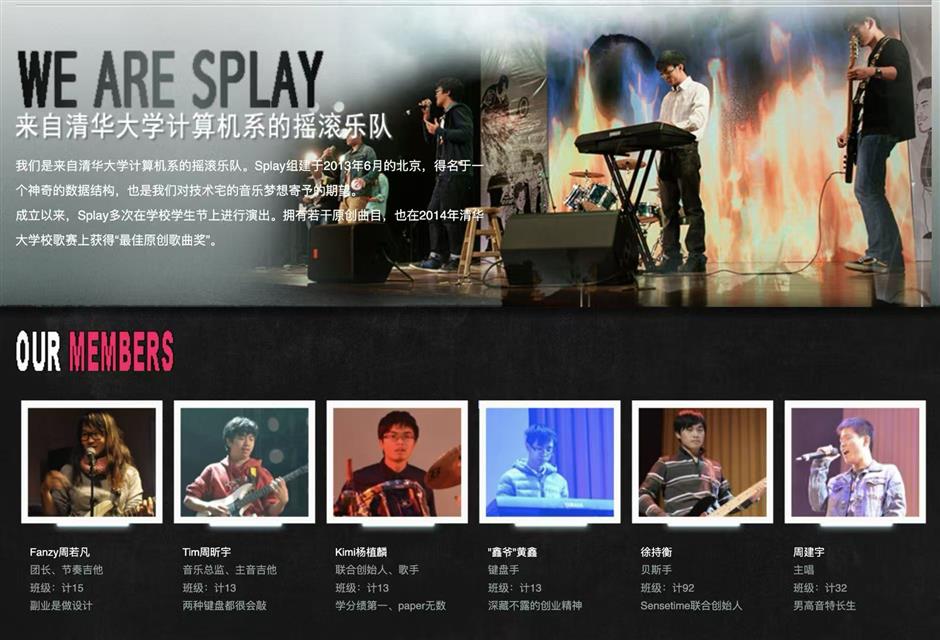
A screenshot from the archived website of Splay, the Tsinghua computer sciences major rock band where Zhou Xinyu (second from left) played guitar and Yang Zhilin (third from left) was the vocal.
It is a small detail, but one that hints at a company culture comfortable with unconventional thinking – a trait that also appears in its technical choices.
While much of the frontier AI race has focused on building larger proprietary models, Moonshot has repeatedly chosen a different path: releasing increasingly capable open-weight models and betting that developers, rather than exclusivity, will become its competitive advantage.
In that sense, K3 does not feel like a sudden breakthrough. It feels like the next step in a strategy that has embraced unconventional bets from the beginning.
Why openness matters
Every major open-weight release strengthens the ecosystem.
Developers gain another frontier model they can deploy and customize. Companies can run models within their own infrastructure, keeping sensitive data inside their own networks while fine-tuning models for specialized applications. Researchers can inspect and experiment with architectures rather than treating frontier models as black boxes. Startups can build products without relying entirely on a single API provider.
Progress compounds across the ecosystem instead of remaining concentrated inside a small number of companies.
K3 matters not only because of its benchmark performance, but because it reinforces that ecosystem dynamic.
But how do open models make money?
Companies exist to generate profit, so the obvious question is: how can open-weight models become a viable business?
The answer is that releasing model weights does not mean giving away the business.
There is also a pragmatic hardware calculation. With advanced US chips restricted, distributing model weights allows more companies and developers to share inference workloads across their own infrastructure. This can reduce pressure on individual labs' GPU clusters while addressing some of the scalability challenges facing API-first deployment models.
Many customers will still prefer managed APIs rather than operating massive models themselves. They are willing to pay for deployment, customization, fine-tuning and long-term support.
Products like Kimi can generate subscription revenue. Unlike earlier Chinese models that competed aggressively on price, Kimi K3 is priced much closer to OpenAI and Anthropic's frontier offerings, signaling confidence that developers will pay for performance. DeepSeek's flagship API is about 17X cheaper than Kimi K3 for output tokens.
Cloud providers such as Alibaba, Tencent and Huawei can benefit from increased demand for computing infrastructure.
But the larger opportunity is the ecosystem itself.
If thousands of developers build applications on your model, your architecture, tooling and developer community become the foundation others build upon.
The model becomes the starting point, not the final product.
Rather than monetizing exclusive access to intelligence, the strategy is to monetize the ecosystem that grows around it.
Openness is not a blank check. Commercial licensing terms still matter, and deploying models at this scale requires enormous computing resources. Success on a coding benchmark is evidence of strong capability, but not definitive proof of overall frontier leadership.
Why it matters
The AI race is increasingly taking shape along two different paths.
Much of the US frontier AI industry remains focused on building the most capable proprietary models and monetizing access through closed APIs.
Many of China's leading AI labs appear to be betting that openness can accelerate adoption, expand developer ecosystems and create more long-term value than keeping frontier models behind closed doors.
In a recent internal letter, Tang Jie, founder of Zhipu (Z.ai), argued that his company was "not pursuing short-term application monetization, but directly targeting the next high ground of artificial general intelligence (AGI)."
He added: "If the destination is AGI, then short-term interests or industry trends are merely scenery along the road to the end-game."
The connection is notable: Tang mentored Moonshot founder Yang Zhilin during Yang's time at Tsinghua University.
That does not mean Chinese AI labs are not competing with each other – they are. But they are also contributing to an ecosystem where each major open release raises the capabilities available to everyone building on top of it.
For everyday users, Kimi K3 means a more capable AI assistant.
For the industry, it signals something larger.
The first phase of AI competition was about building the smartest models.
The next phase may be about building the largest ecosystems around them.
Kimi K3 suggests China's open approach is not simply an alternative to the closed-model strategy. It represents a different theory of competition:
Do not just build the best model. Build the ecosystem everyone else wants to build on.







- 报料热线: 021-962866
- 报料邮箱: news@thepaper.cn
互联网新闻信息服务许可证:31120170006
增值电信业务经营许可证:沪B2-2017116
© 2014-2026 上海东方报业有限公司