
- +1
Create Internal and External Conditions for Devel…
原创 Zhang Mei 中国投资参考

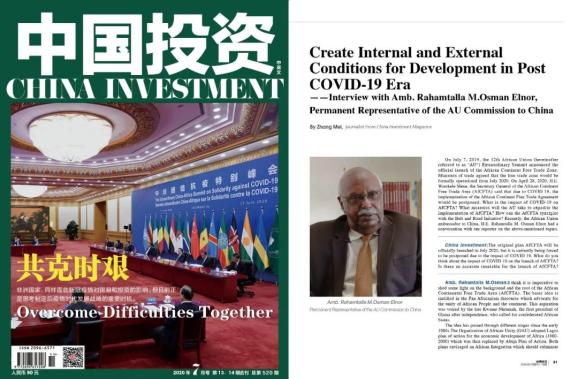

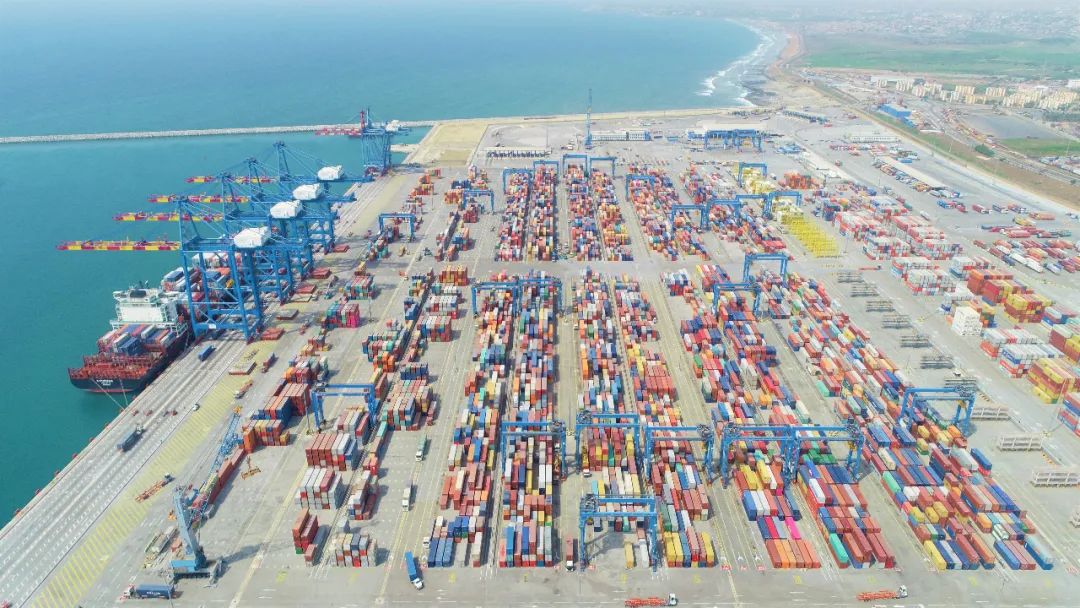
China Investment:The original plan AfCFTA will be officially launched in July 2020, but it is currently being forced to be postponed due to the impact of COVID-19. What do you think about the impact of COVID-19 on the launch of AfCFTA? Is there an accurate timetable for the launch of AfCFTA?
Amb. Rahamtalla M.Osman:I think it is imperative to shed some light on the background and the root of the African Continental Free Trade Area (AfCFTA). The basic idea is instilled in the Pan Africanism discourse which advocate for the unity of African People and the continent. This aspiration was voiced by the late Kwame Nkrumah, the first president of Ghana after independence, who called for confederated African States.
The idea has passed through different stages since the early 1980s.The Organization of African Unity (OAU) adopted Lagos plan of action for the economic development of Africa (1980-2000) which was then replaced by Abuja Plan of Action. Both plans envisaged an African Integration which should culminate in the African Economic Community (AEC). When the OAU was replaced by the African Union in 2000.The African leaders adopted an ambitious program entitled Agenda 2063 as a vehicle or locomotive for the African integration and prosperity. The AfCFTA is the main pillar of this Agenda.
The main objectives of the AfCFTA are to create a free trade area covering goods and services with free movement of persons and investments with the ultimate objective of deeper integration including a customs union and a single market. It is also envisaged to boast the intra Africa trade which stands now at 15% to 17% of the total trade of the continent which is far below other regions like Europe (68%), Asia (59%), and America (55%). With the implementation of the AfCFTA, the intra African trade is expected to reach 50% of its total exports by 2022. The AfCFTA would unite 1/ 3 billion people and create 3 /4 trillion US dollars economic block, which has become the largest since the creation of the WTO. It is expected to unlock Africa’s economic potential by boosting the Intra African trade and strengthen supply chains.
The AfCFTA was signed in Kigali( Ruwanda) by 44 African countries on March 1st, 2018 and launched in July 2019 in Niamey (Niger). Since that time 28 countries ratified and deposited their instruments. It was planned to start the implementation by July 1st 2020, but due to the outbreak of the Covid-19, it proved to be impossible to attain this goal. It is even very much uncertain to speculate about new launching date.

China Investment:At present, what is the level of African countries' commitment to the implementation of the African Free Trade Area? How are countries preparing for AfCFTA? What challenges does AfCFTA face?
Amb. Rahamtalla M.Osman:As I said earlier all AU 55 member states have signed the AfCFTA agreement and 28 countries have ratified it. This shows the commitment to implement the agreement. The outbreak of the Covid-19, had delayed the implementation which was decided to be on July 1st, 2020. However, some practical steps were already taken including: (1) the establishment of trade and goods portal/website which allows countries to upload their initial tariff offers. (2) Pan-African digital payment and settlement system. (3) Online tool or mechanism to eliminate non-tariff barriers. (4) Establishment of permanent secretariat in Accra (Ghana) and a secretary General was elected.
Beside these steps, the countries should continue to adapt their national plans to take necessary measures to liberalize their goods and services to be ready for the new implementation date as circumstances may permit. This period will also offer an opportunity to pursue progress towards subsequent phases like investment, Intellectual Property (IP) right, e-commerce as well as productive transformation agenda, through regional integration as these measures were keys to reducing vulnerability to external shocks in trade and commodity.
It is also worth mentioning that as part of the preparation for the implementations, the African Union is partnership with AfroChampions Initiative officially launched a trillion-investment framework in Kigali on October 2019, to fully operationalize the AfCFTA, through private sector-driven investments in different sectors by 2030. This trillion dollar has been designed to promote PPP investments. As such, it will allow foreign capital to partner with local firms to develop the natural resources and inject best practices and technologies in the process.
China Investment:Some experts said that COVID-19 brings opportunities to AfCFTA. Do you agree with this view? What opportunities does it bring? How should African countries seize these opportunities?
Amb. Rahamtalla M.Osman:The challenges facing African countries are enormous due to the fragile structures of their economies, which were further aggravated by the pandemic. Most of their economies depend heavily on the export of raw material that goes to countries which are themselves suffering from the outbreak of the Covid-19. This has subdued effect on African exports. Africa’s service sector is also set to fall between 20-30% namely the tourism. The impact of the pandemic goes beyond the health risk and it shocks the African economy in three main areas:
-Lower trade and investment from China in the immediate term
-Demand slump for its exports of raw materials, due to the lockdown of its major partners in OECD countries.
-The shock has also affected the continent domestic supply and the already poor intra-African trade.
With regard to the challenges facing the implementation of the AfCFTA, some countries were concerned of being flooded with low cost goods, which will confound their internal efforts to promote their local manufacturing and agricultural production. To mitigate their concerns, it is imperative that the implementation of the AfCFTA should be designed in a way of complementarity between companies to help each other as other regions (Europe) has done.
To avoid this, the AfCFTA agreement has enshrined preferential treatment mechanism for the most at risk economies. It also encourages participating countries built an efficient and participatory institutional architecture to make sure that no country is left behind. Otherwise the liberalization has the potential of damaging the poorest economies and in turn this may lead to the defeat of the basic objectives of the continental integration.
The other major difficulty which faces the African economies in the post Covid-19 era is persistent current account imbalances resulting from the trade deficits. As domestic revenue mobilization remains low in Africa, many countries rely heavily on foreign sources for financing their deficits through FDI portfolio investments, remittances and ODA. All these means were expected to shrink. This will in turn restraint the capacities of African economies, and their development plans, and will lead to currency depreciations. This will be added to the challenges which will have negative repercussions on the smooth implementation of the AfCFTA.
No doubt the Covid-19 has reshaped the global economic realities and compel all to adapt and revise their development plans. African countries have realized this challenge and embarked on designing new ways and means for facing the enormous ramifications of the post Covid-19 period. They are cognizant of the fact that dependence on the international community this time will not be a panacea because of the difficulties all countries facing as indicated earlier. The solution is to rely on their own resources and capabilities. They need to be more resilient to build sustainable economies. They would adapt policies which focus on, diversification of their economies with greater emphasis on strategic sectors like food and health, embracing digitalization to enhance industrialization of services and strengthening intra-regional trade by adhering to implementation of AfCFTA.
The effective implementation of the AfCFTA and AU productive transformation as enshrined in the 2063 Agenda will strengthen regional value chains, reduce vulnerability to external shocks. Furthermore, the total integration of the African economies on a continental scale is the only way to achieve anything like the levels of the developed countries. This vision was amply stated by H.E. the Chairperson of the African Union Commission in his declaration for the commemoration of Africa Day on 25 May 2020, “we should in full lucidity, boldly opt for an innovative approach that is inward-looking rather than outward-looking. Let us live on what we have, using what we have, in other words let us live within our own means”.
China Investment:What kind of help can China provide in the construction of AfCFTA?
Amb. Rahamtalla M.Osman:Africa expects a lot from China with regard to the implementation of the AfCFTA on the basis of the on-going cooperation and partnership. The rich Chinese experience which it acquired over the past four decades is very inspiring in terms of the results achieved especially the poverty alleviation which Africa needs. The success of the AfCFTA depends mainly on the development of the infrastructure sector to pave the way for easy mobility of people and goods. China had already embarked on some major projects which facilitate connectivity between countries. These projects were beneficial to Africa and tally with China policy of Belt & Road.
Africa would like also to benefit from the rich knowledge of China in the digital transformation which will in turn facilitate the technologies transfer and adding value to African exports, integrating African producers into the Chinese production sharing network. Africa is appreciative to the commitment of China to support the AfCFTA which was announced by President Xi Jinping during the Covid-19 extraordinary Summit on June 2020.
Editor | Zhang Mei
Design | Sun Ziyue
本文刊于《中国投资》2020年7月号。版权所有,侵权必究。欢迎个人分享,媒体转载请回复本微信号获得许可。
《中国投资》杂志创办自1985年,由国家发改委主管,国家发改委投资研究所、中国国际工程咨询有限公司主办,是我国投资领域唯一的中央级刊物,业界最早专注于投资领域趋势报道的核心期刊。创刊三十多年以来,杂志以全球视角看中国投资,涵盖宏观经济、行业分析和企业投资案例,同时以全球市场为坐标,聚焦特定国家、地区和重大国际趋势,目前已经成为世界各国政府官员、各类投资机构、专家学者、企业家以及记者媒体的专业对话平台。
《中国投资》杂志每期覆盖包括上市公司在内的200多家央企国企和10000多家中国民营企业、1000多家中央与地方政府决策部门和机构、1000多家行业协会和商会、300多家主要金融机构等,是了解宏观经济环境、行业趋势前景和企业投资案例的重要参考。
自2016年始,在中联部等相关机构的共同支持下,《中国投资》非洲版面世,为非洲各国与中国持久的大规模合作,提供一个专业而强大的对话平台。
2017年,《中国投资》丝路版诞生,为一带一路框架下各国各方与中国的合作互鉴,提供前瞻包容的思想引领,分享各行各业的创新创举,在探索人类命运共同体的道路上共创未来。
China Investment, founded in 1985, is a monthly under the supervision of National Development and Reform Commission (NDRC) China’s macro-economic management agency, It’s jointly operated by Investment Research Institute under NDRC, China International Engineering Consulting Corporation. Enjoying an exclusive position under the central government, China Investment is the core journal which started the earliest among similar magazines to focus on the investment trend. Over the past 30-plus years, China Investment has been in line with theglobal market as its fundamental coordinate with a strategic focus on specific countries and regional markets and those major international propensities. China Investment is a key dialogue platform for officials from different countries, investment agencies, experts and scholars, business people and journalists.
China Investment has been a key source of references for the better understanding of macro-economic environment, sectoral and industrial outlook, and cases of investments, thanks to the fact that each of its new issue touches upon activities of more than 200 Chinese SOEs, listed or non-public, 10,000 private enterprises, 1000 decision-making bodies at the central and local governments, 1000 trade associations and chambers, and 300 strong major financial institutions.
Starting from May 2016 and under the auspices of the Ministry of Foreign Affairs and International Department of the Central Committee of Communist Party of China, China Investment African Edition came into being, providing a professional and powerful platform of dialogue for the ever-growing and sustainable cooperation between China and the African countries throughout the continent.
Inspired by Belt and Road Initiative, China Investment Belts & Roads Edition was born in May 2017, which provides forward thinking for the cooperation and mutual learning between China and related countries. It also aims to share the innovative ideas in various trades and industries and explore a shared future in building a common community formankind.
原标题:《Create Internal and External Conditions for Development》
本文为澎湃号作者或机构在澎湃新闻上传并发布,仅代表该作者或机构观点,不代表澎湃新闻的观点或立场,澎湃新闻仅提供信息发布平台。申请澎湃号请用电脑访问http://renzheng.thepaper.cn。







- 报料热线: 021-962866
- 报料邮箱: news@thepaper.cn
互联网新闻信息服务许可证:31120170006
增值电信业务经营许可证:沪B2-2017116
© 2014-2026 上海东方报业有限公司