
- +1
阿尔茨海默病真的是3型糖尿病吗?②
原创 KimberlyBjugstad 阿尔茨海默病
胰岛素和ApoE等位基因
无论周期从何处开始,胰岛素都在痴呆症中起作用,并可能在痴呆症的治疗中发挥作用。首先,应该承认长期使用胰岛素来控制糖尿病会增加患痴呆症的风险。接受胰岛素治疗的糖尿病患者罹患痴呆症的可能性是通过饮食和生活方式改变来控制疾病的糖尿病患者的两倍。
急性胰岛素治疗虽然已显示可暂时改善认知功能,但存在风险。为了改善认知,通过外周给药,使胰岛素进入中枢神经系统,有发生低血糖事件的风险。因此,一些研究调查了急性鼻内胰岛素给药的使用,其不改变血糖或胰岛素水平。这些研究发现,鼻内胰岛素治疗(20-40 IU)后,AD和轻度认知障碍(MCI)患者在延迟回忆、列表学习和故事回忆方面的得分均有所提高,但是研究组之间存在很大差异。这种变异性可能与迟发性阿尔茨海默病(LOAD)相关的特定遗传特征有关。
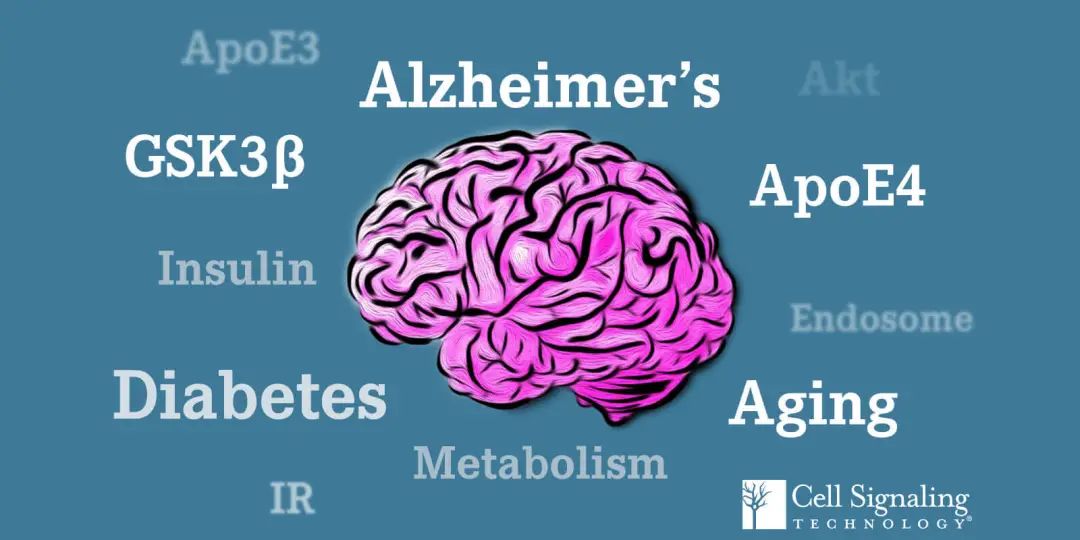
ApoE参与运输和处理细胞膜的不同成分,包括APP / Aβ、胆固醇和脂蛋白。它参与膜功能可能是ApoE4 阳性和ApoE4阴性痴呆患者胰岛素治疗后反应可变背后的机制。有记录表明,在ApoE4 阳性的大脑中,胰岛素受体较少,血脑屏障的通透性增加,脑血管壁变薄。

许多研究证实了这一观察,即迟发性阿尔茨海默病和痴呆症与糖尿病相关。然而,将这两种类型的痴呆症归为一个单一的名称——3型糖尿病(Type 3 Diabetes),还是需谨慎。Potter博士进一步告诉内分泌网(Endocrine Web):
“综合这些事实,一些研究人员认为,阿尔茨海默病应被视为3型糖尿病。这可能仍然是正确的。然而,据报道,一种合理的解决方案(通过鼻喷剂为大脑提供额外的胰岛素)对改善甚至减缓正在进行的认知功能下降无效。显然,还需要做更多的工作。”
两种疾病都直接进入共同的病理生理途径,但是推测其他不相关或间接的途径也参与其中并非没有道理。正如Potter博士所指出的,还需要做更多的工作,并且考虑到涉及的遗传学、药物遗传学方法可能在两种疾病中起主导作用。

参考文献
Source:endocrineweb
Is Alzheimer’s Disease Really Type 3 Diabetes?
References:
Kroner Z. The relationship between Alzheimer's disease and diabetes: Type 3 diabetes? Altern Med Rev. 2009;14(4):373-379. https://www.ncbi.nlm.nih.gov/pubmed/20030463
Steen E, Terry BM, Rivera EJ, et al. Impaired insulin and insulin-like growth factor expression and signaling mechanisms in Alzheimer's disease--is this type 3 diabetes? J Alzheimers Dis. 2005;7(1):63-80. https://www.ncbi.nlm.nih.gov/pubmed/15750215
Ott A, Stolk RP, Hofman A, van Harskamp F, Grobbee DE, Breteler MM. Association of diabetes mellitus and dementia: the Rotterdam Study. Diabetologia. 1996;39(11):1392-1397. https://www.ncbi.nlm.nih.gov/pubmed/8933010
Ott A, Stolk RP, van Harskamp F, Pols HA, Hofman A, Breteler MM. Diabetes mellitus and the risk of dementia: The Rotterdam Study. Neurology. 1999;53(9):1937-1942. https://www.ncbi.nlm.nih.gov/pubmed/10599761
Craft S, Asthana S, Cook DG, et al. Insulin dose-response effects on memory and plasma amyloid precursor protein in Alzheimer's disease: interactions with apolipoprotein E genotype. Psychoneuroendocrinology. 2003;28(6):809-822. https://www.ncbi.nlm.nih.gov/pubmed/12812866
Nguyen TT, Ta QTH, Nguyen TKO, Nguyen TTD, Giau VV. Type 3 Diabetes and Its Role Implications in Alzheimer's Disease. International journal of molecular sciences. 2020;21(9). https://www.ncbi.nlm.nih.gov/pubmed/32365816
Nguyen TT, Ta QTH, Nguyen TTD, Le TT, Vo VG. Role of Insulin Resistance in the Alzheimer's Disease Progression. Neurochem Res. 2020;45(7):1481-1491. https://www.ncbi.nlm.nih.gov/pubmed/32314178
Gray SM, Meijer RI, Barrett EJ. Insulin regulates brain function, but how does it get there? Diabetes. 2014;63(12):3992-3997. https://www.ncbi.nlm.nih.gov/pubmed/25414013
Koepsell H. Glucose transporters in brain in health and disease. Pflugers Arch. 2020;472(9):1299-1343. https://www.ncbi.nlm.nih.gov/pubmed/32789766
Rhea EM, Raber J, Banks WA. ApoE and cerebral insulin: Trafficking, receptors, and resistance. Neurobiol Dis. 2020;137:104755. https://www.ncbi.nlm.nih.gov/pubmed/31978603
Aljanabi NM, Mamtani S, Al-Ghuraibawi MMH, Yadav S, Nasr L. Alzheimer's and Hyperglycemia: Role of the Insulin Signaling Pathway and GSK-3 Inhibition in Paving a Path to Dementia. Cureus. 2020;12(2):e6885. https://www.ncbi.nlm.nih.gov/pubmed/32190448
Farris W, Mansourian S, Chang Y, et al. Insulin-degrading enzyme regulates the levels of insulin, amyloid beta-protein, and the beta-amyloid precursor protein intracellular domain in vivo. Proc Natl Acad Sci U S A. 2003;100(7):4162-4167. https://www.ncbi.nlm.nih.gov/pubmed/12634421
Ling X, Martins RN, Racchi M, Craft S, Helmerhorst E. Amyloid beta antagonizes insulin promoted secretion of the amyloid beta protein precursor. J Alzheimers Dis. 2002;4(5):369-374. https://www.ncbi.nlm.nih.gov/pubmed/12446969
Norwitz NG, Mota AS, Norwitz SG, Clarke K. Multi-Loop Model of Alzheimer Disease: An Integrated Perspective on the Wnt/GSK3beta, alpha-Synuclein, and Type 3 Diabetes Hypotheses. Front Aging Neurosci. 2019;11:184. https://www.ncbi.nlm.nih.gov/pubmed/31417394
Potter H, Wisniewski T. Apolipoprotein e: essential catalyst of the Alzheimer amyloid cascade. Int J Alzheimers Dis. 2012;2012:489428. https://www.ncbi.nlm.nih.gov/pubmed/22844635
Weinstein G, Davis-Plourde KL, Conner S, et al. Association of metformin, sulfonylurea and insulin use with brain structure and function and risk of dementia and Alzheimer's disease: Pooled analysis from 5 cohorts. PLoS One. 2019;14(2):e0212293. https://www.ncbi.nlm.nih.gov/pubmed/30768625
Reger MA, Watson GS, Frey WH, 2nd, et al. Effects of intranasal insulin on cognition in memory-impaired older adults: modulation by APOE genotype. Neurobiol Aging. 2006;27(3):451-458. https://www.ncbi.nlm.nih.gov/pubmed/15964100
Reger MA, Watson GS, Green PS, et al. Intranasal insulin administration dose-dependently modulates verbal memory and plasma amyloid-beta in memory-impaired older adults. J Alzheimers Dis. 2008;13(3):323-331. https://www.ncbi.nlm.nih.gov/pubmed/18430999
Reger MA, Watson GS, Green PS, et al. Intranasal insulin improves cognition and modulates beta-amyloid in early AD. Neurology. 2008;70(6):440-448. https://www.ncbi.nlm.nih.gov/pubmed/17942819
Correia SC, Santos RX, Carvalho C, et al. Insulin signaling, glucose metabolism and mitochondria: major players in Alzheimer's disease and diabetes interrelation. Brain Res. 2012;1441:64-78. https://www.ncbi.nlm.nih.gov/pubmed/22290178
本文为澎湃号作者或机构在澎湃新闻上传并发布,仅代表该作者或机构观点,不代表澎湃新闻的观点或立场,澎湃新闻仅提供信息发布平台。申请澎湃号请用电脑访问http://renzheng.thepaper.cn。







- 报料热线: 021-962866
- 报料邮箱: news@thepaper.cn
互联网新闻信息服务许可证:31120170006
增值电信业务经营许可证:沪B2-2017116
© 2014-2026 上海东方报业有限公司